Exploring System Design, Cloud Architectures, and the evolving role of AI / ML in modern software. Grounded in real-world experience building and scaling systems; Less theory, more signal.
Are Small Language Models the Future of Agentic AI?
Get link
Facebook
X
Pinterest
Email
Other Apps
The AI world has placed its bets on large language models (LLMs) as the default brain for AI agents. This bet has become so entrenched that entire infrastructures, venture bets, and enterprise rollouts have been built around this paradigm. But what if this default isn’t the only option?
During a recent weekend reading session, I stumbled upon a paper from NVIDIA Research and the Georgia Institute of Technology: “Small Language Models are the Future of Agentic AI.” The paper argues that for many tasks, the future is not LLM-only, and after interrogating its claims, I believe it’s not SLM-only either. The future is hybrid.
At its core, the paper suggests that small language models (SLMs) are powerful enough to run on consumer hardware with fewer than 10B parameters. It makes a compelling case based on three key points:
SLMs are already powerful enough for most agentic tasks.
They hallucinate less and are easier to constrain, making them operationally more reliable.
They are relatively cheaper to train, fine-tune, and run.
The paper notes that agents don’t require broad, generalist abilities. Instead, they need narrow, repetitive, deterministic, and schema-stable outputs. In their tests, between 40% and 70% of real-world agent workloads could be handled by SLMs without loss of quality. On the surface, the logic is sound: why pay for LLM inference when smaller models can do the job just as well?
While the theory for SLMs looks straightforward, it often bends under the weight of practical design choices. Let’s unpack a few areas where the rubber hits the road.
The Orchestration Challenge: Micro vs. Domain SLMs
Imagine building a travel booking platform. You could choose one of two paths:
Option 1: Micro-SLMs. A handful of small models, each dedicated to a narrow task like flight booking, hotel reservations, or car rentals. Each is fine-tuned to produce perfectly formatted JSON and never deviates from its purpose.
Option 2: Domain-SLM. A single, mid-sized travel-specific model that manages the entire process end-to-end — flights, hotels, cars, and insurance.
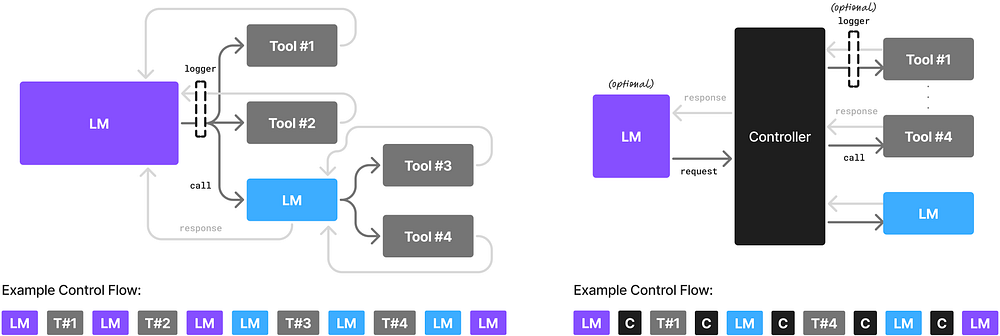
The paper leans toward micro-SLMs, asserting that agents thrive on narrow, structured tasks. But this introduces its own complexities. You need robust orchestration, routing, and planning to know exactly which SLM to call and how to stitch outputs together. That planner requires detailed metadata for every micro-SLM: endpoint details, schemas, error-handling rules. Without a governance layer, you risk creating a spaghetti system as fragile as the problems it was meant to solve.
The Economics: Training vs. Inference
The economics case is strong. Fine-tuning an SLM can be done overnight on a single GPU. Inference costs are an order of magnitude lower (10 to 30 times lower than LLMs). Edge deployment offers privacy and latency benefits.
But numbers can hide complexity. Maintaining dozens of micro-SLMs multiplies operational costs: monitoring, retraining, compliance checks, integration maintenance. Centralized LLM inference may look expensive, but hyperscalers squeeze efficiencies out of scale that individual teams cannot match.
Another overlooked factor is the token economy. Agents rarely make one massive call; they make many small, repeated calls for schema checks, validation, and retries. With LLMs, every call often consumes a large context window whether you use it fully or not, leading to wasted tokens. SLMs, with smaller context limits and schema-bound outputs, naturally waste fewer tokens per step. At scale, this compounds into real savings.
So the economics are not one-sided. SLMs shine when cost-per-task is paramount, but orchestration and operational overhead can quietly erode those savings if not managed carefully.
Where SLMs Fit, Where LLMs Stay Relevant
The idea that “SLMs will replace LLMs” is too binary. More likely, the industry will split roles
SLMs will become the default executors of structured, deterministic tasks — form-filling, API calls, workflow automation.
LLMs will remain planners and safety nets, handling messy, ambiguous, or cross-domain reasoning.
Think of it like edge vs. cloud computing: SLMs are cheap, local, efficient, and specialized; LLMs are centralized, heavy-lift, and premium.
The Missing Piece: Governance
The paper highlights barriers like sunk infrastructure costs and poor benchmarks, but it downplays governance. And governance isn’t optional — it’s the difference between a manageable SLM ecosystem and an untraceable web of shadow models.
Without it, teams risk duplicating models for the same task, letting schema drift creep in, or losing accountability when outputs fail. If the future is SLM-heavy, enterprises will need:
Registries of available SLMs and their schemas.
Versioning and performance metadata.
Orchestration frameworks that can scale reliably, instead of collapsing into fragile collections of hand-written routing scripts
Without this governance layer, the cost advantages of SLMs evaporate in operational chaos.
My Final Take
The paper is right in spirit. LLMs can be overkill for much of agentic work, and SLMs are well-positioned to take over repetitive, structured workloads. The case studies show that up to 70% of tasks could already shift today.
But the real story isn’t “SLMs will replace LLMs.” It is hybrid systems that blend both, with SLMs as efficient executors and LLMs as flexible orchestrators. The real differentiators will not be the companies chasing hype, whether that means throwing LLMs at every problem or blindly spinning up SLMs for every task. It will come from building disciplined, well-governed ecosystems where each model type plays to its strengths. In the end, it is not model size that will define differentiators, but governance and discipline.
Introduction Does statistical machine learning still make sense in the age of LLMs? This isn’t an academic question, it shows up in product meetings, technical brainstorming, and post-mortems. Someone proposes, “Can we explore GPT/Claude/LLaMA or an open-source model or latest paper,” and the room tilts toward the shiny option. The clout around LLMs is real: they can feel like the easiest answer to every problem because the rapid pace of technical content and the flood of new tools creates FOMO. That pressure seeps into our technical decisions. I want to ground this in personal experience . In my product meetings, the proposal to use LLMs comes up all the time. Even when we have proven, homegrown models, the allure of LLMs often overshadows rational thinking. This is where you have to really dig in, understand the nitty-gritty, and validate the problem and solution from both a macro and micro perspective. That paragraph isn’t a lament, it’s the setup for this post. This isn’t n...
Introduction In this post, I introduce a simple search application in the background of Amazon CloudSearch and domain Digital Asset Management (DAM). The primary objective of this search application is to exhibit search capabilities of Amazon CloudSearch with the functionality of Digital Asset Management. Further, we will also will setup and deploy the search application and see it from an end to end perspective. The application will have source code examples for essential DAM functionalities like digital asset file upload, metadata extraction and storing file related information in a persistence store & search store. We will also share the application source code that will help developers to reuse, extend and customize further. The below illustration depicts the system workflow of the DAM search application. System Flow Technology stack The DAM search application is built using Java programming language. The functionality of DAM is developed in API model. It requires on...


Comments
Post a Comment